
More Than Meets The Eye
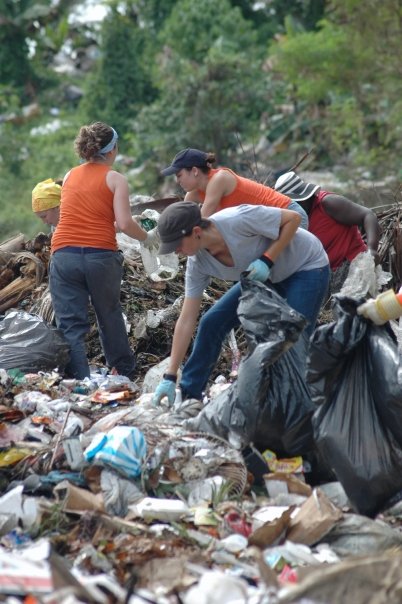 It would have been hard to see what was really going on that day. It didn’t look like much more than a group of people standing around a kid with a bleeding nose, wondering if he was going to be ok, and then slowly turning around and going back to work. Only he wasn’t really ok, it wasn’t a regular group of people, and we were all standing beside huge mounds of garbage overheating in the Caribbean sun. Not really a typical scene after all.His name is Ganasse. He is 10 years old. He lives in a quiet little village that I have many friends in. His dad died when he was only a baby. He has an older brother that works out of town and his mom is “in the hospital” two hours away. He is Haitian and he is without any proper identification papers. He works in a garbage dump and he is as tough as nails. I don’t really think his mom is in the hospital – I think she is never coming back to him. She has been “in the hospital” since I have known him and I think no one in the village has the heart to tell him she isn’t coming home. In all reality, Ganasse is a stateless orphan, and his future is largely determined for him at this point in time.One of the Hero Holiday students with me that day at the garbage dump brought me over to see him when they found him sitting to the side. He was trying to make his nose stop bleeding. Sitting down beside Ganasse with a pile of tissue and wipes, I tried to help him understand how to stop the bleeding. With one hand I held his tiny, dirty hand and with the other I wiped his tears that were streaming down his face. Liquid brown eyes searched mine and I could see the fear in them. He wasn’t just a kid with a bleeding nose. He was young boy who didn’t know what tomorrow would hold. He was a child without a mother or father and this garbage dump was almost all that he knew of life. He had spent most of his life being on the outside and looking in: wondering what it was to have a family, dreaming of what he would someday like to be and having to figure out how to survive today.
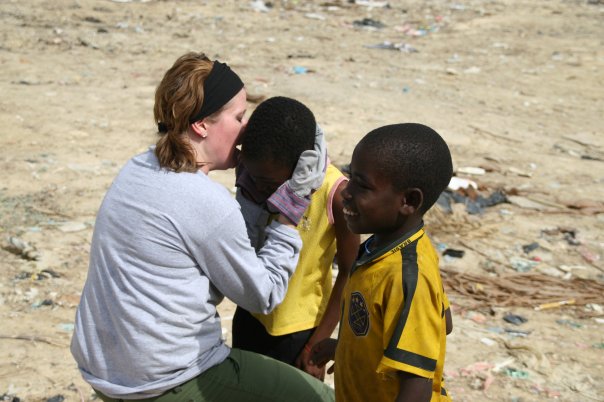 As I held his hand, he leaned his head against my shoulder, never saying a word. I didn’t move. I didn’t want to. Finally, I raised my arm around his shoulder and hugged him close. He snuggled in and didn’t move for a moment, soaking in the human contact. This was something I had failed to realize: the power of human touch to heal the heart. When was the last time he had been hugged? Did he have any memories of human tenderness and touch? Did he crave being noticed? Had he ever felt he was someone worth holding on to?His nose had stopped bleeding, and he had stopped crying, but my heart was broken. Sitting on the side, watching everyone around us working, I saw life from his perspective for a moment: adults rushing to find food and supplies to provide for their own hungry families, loud dump trucks roaring past us, flies buzzing frantically around the heated refuse, two lone palm trees with leaves barely moving in the near stagnant air, and the anxious faces of Canadian teenagers who were continually looking back and checking to see if we were all right. I realized how high the mounds of garbage looked from this angle and how focused and determined each of the adult workers were to find what they were looking for. This was no place for anyone to have to work in, let alone a ten year old boy. Like each of these workers that I saw in front of me, Ganasse deserves more. He deserves a future.
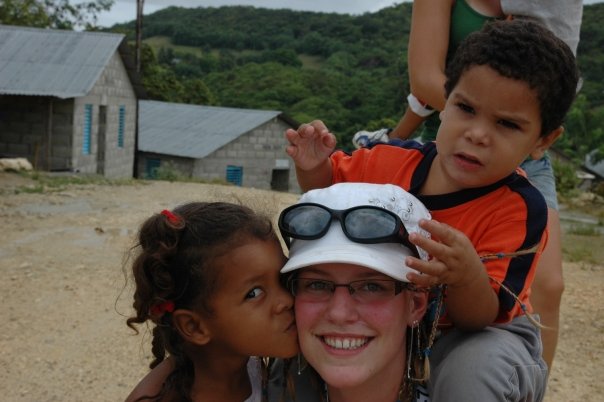 Like me, the Canadian students with me that day learned many life lessons. Some of us are probably still processing those lessons even now. But that tender moment with Ganasse left us with something more than questions and frustrations: it deposited a resolve in each of our hearts. The resolve to continue to be a voice, the resolve to recognize the power of each of our lives and choices, and most of all, the ability to see how we can make a difference one life at a time. Today, there is a school in Ganasse’s village that we helped to expand to include more kids such as himself. Ganasse is in a home with a family and he is being taken care of. And today, like the Canadians that joined me in that garbage dump, I am determined to work harder than ever to make the world a little less scary for the Ganasse’s out there.You can join us on a Hero Holiday in Dominican Republic in July of 2010! To find out more, check out www.heroholiday.com.Our obligation is to give meaning to life and in doing so to overcome the passive, indifferent life. ~ Elie Wiesel


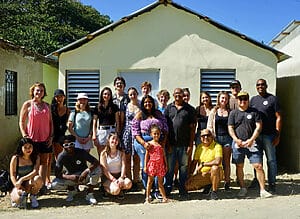
 We built a house for a single mother who has 2 children, a 12 year old girl and a 13 year old boy, and we were told that just this August, Misiel, the 13 year old boy was riding his bike with his father when a drunk driver hit him. His foot was crushed in the accident which later got infected and the doctors needed to amputate most of his leg. His leg is no longer infected and he now has a wheelchair. I was very sad when I heard this story but felt better to know that we were going to help and try to make his every day life a little easier. Misiel is a boy who has lots of energy and just loves music. It made me really sad to see him watching all his friends play, because you could see in his eyes that he wanted to run and play with them.
 When we started building this home we could tell there was a lot of love for this family from the community, we always had lots of kids who wanted to play football (soccer) with us and some kids just wanted to help us work. The girls especially loved the paint because it was pink and purple and they would put it on their nails to make it look like nail polish. We also had help from our friends, Mundo and Danny. Mundo is our translator for our English class and Danny is a friend. Together they dug a hole for the bano, they worked really well together and learned a lot from each other. Mundo told us that when he was in the hole digging, he would tell Danny some of his life stories, and when Danny was in the hole digging it was his turn to tell stories. The kids were so happy and playful; they were a constant reminder to us why were there helping out. I really connected with a little girl named Maria, she lived close to the house build. Her father made donuts and pizza so he could make some extra money for his family, but mostly to support his other daughter who has a disability. My team and I made sure to buy donuts from him everyday to help them out. Maria was always happy and excited to see me, she made me realize that it’s the little things that matter in life.While we were building the house we started thinking of ways that would make it easier for Misiel to get around in his wheelchair. So we built them a shower and also bigger bano so he could easily get his wheelchair in and out. Brett, my leader, also thought of putting bars around his room to make it easier for him to start walking again. When we gave the keys to the house to this amazing family, everyone said some inspiring words and welcomed them to their new home. The mother and daughter had lots of tears, but they thankfully were
  tears of joy. My mom and her friend decided to buy big bags of rice and beans for them as well, and also at the end of the week we went around and gave little bags of rice and beans to families in the community. So far, this has been my favorite house build. I love that I got to build it with my mom and my new School of Leadership family.~ Melissa, a School of Leadership student living in Mexico and painter extraordinaire.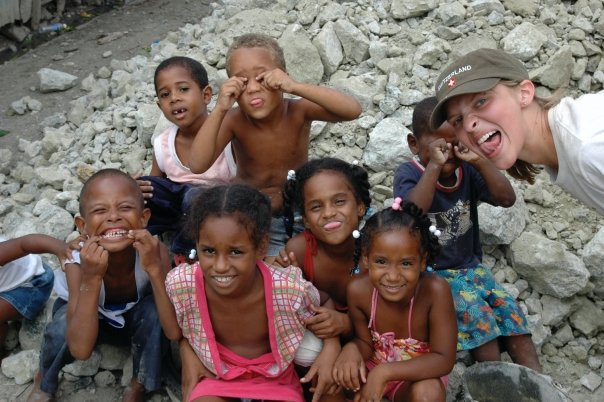





 They are only the elite, specially selected few.They parade across our stage brandishing their weapons of choice. These are no ordinary instruments of torture, unusually, they are in the form of a broom, hockey stick, and a severed pool noodle. These ‘creme of the crop’ are showing us their rock and roll moves like never before (literally, I don’t think any of them have ever done this before!). They head bang as in the days of their youth, and while doing so there are generally three items that come spilling from their pockets.Keys, pens, and paperclips.Once in a while there will be an unlucky individual who flings their glasses inadvertently across that glossy hardwood floor not caring a bit, because they need to rock harder than their students did. They will let nothing stand in the way of their ETERNAL GLORY! For that is what they will receive if they can rock harder than a bunch of high school wussies!
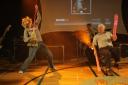 These are the teachers who have bravely sacrificed eyesight and dignity alike to participate in our “school of Rock” and no matter how many teachers we see on stage we are always shocked at how well they perform!Canada has some of the most amazing teachers, many of which end up on our stage and its their students who choose them because they know that these are the teachers who know how to have fun. These are the teachers who are trusted and liked by their students. They are the elite only because of the dedication to their students, dedication that is clearly seen when they rock out no holds bar to make sure their students get a laugh! we congratulate you teachers who are chosen for our air band rock off because you are the teachers who care for their students. We did not preselect you, you were chosen by the students you teach. In fact its almost as if you selected yourselves. How you ask? By being there for your students, approachable, and friendly. You selected yourselves when you decided to love kids and not just teach them. Our country is full of teachers and administratorswho love their students, who only want the best for them and their futures. A lot of the time you are the elite, the specially selected few, who will humbly rock out with us, and for some reason you are always carrying in those magnanimous pockets of yours:Keys, Pens, and Paperclips